


The Psychology of Skin: Why Authority Is a Visual Contract (Not a Moral Debate)

In every room, before we speak or introduce ourselves, we are visually processed—often within seconds.

And one of the most misunderstood visual signals in professional dressing is the degree of skin shown.
It appears in small decisions that people treat as purely aesthetic or modesty choices:
Long sleeves vs. short.
Closed collars vs. open necklines.
Long socks vs. no-show socks.
Closed shoes vs. sandals.
This conversation is often reduced to morality or outdated conservatism, when in fact, it has very little to do with any of those things. It is about how visual cues communicate credibility, hierarchy, and authority—because authority, at its core, functions as a kind of psychological contract.
Clothing Is Social Signaling
Social psychology research consistently shows that clothing significantly influences how others perceive competence, status, and professional role (see person perception research such as Slepian et al., 2015; Howlett et al., 2015).
In everyday interactions, humans rely heavily on visual shortcuts—what psychologists call heuristics—to quickly interpret social situations. Within moments of seeing someone, we make judgments about who might be in charge, who seems knowledgeable, who feels more friendly, and who occupies a what position within the hierarchy.
Clothing becomes one of the fastest systems through which our sub-conscious brain answers these questions. And authority consistently correlates with these 4 visual markers:
Structure
Coverage
Precision
Boundary
These signals work because the human brain reads visual cues as shortcuts for discipline, hierarchy, and credibility long before a conversation even begins.
Not morality. But Boundary.
Why “Less Skin” Often Signals “More Authority”
Across cultures and professions, more covered silhouettes often read as more authoritative. This happens because visible skin subtly changes how the brain interprets a social interaction.
First, it alters psychological distance. When more skin is visible, the body becomes more present than the role, and attention shifts from position to person. Professional leadership signals typically require the opposite dynamic, where the role takes precedence over the individual body. This is not about shame or modesty; it is about cognitive framing.
Second, exposed extremities such as shoulders, legs, and toes tend to signal relaxation, leisure, and private environments. Bare feet in particular are neurologically linked with domestic space. When toes are visible, the brain often registers a subtle signal of comfort or informality—almost as if the individual is socially “at home.” Professional settings, by contrast, traditionally rely on a degree of formality to maintain hierarchy and role clarity.
Third, clothing also shapes the psychological frame of an interaction. Research on enclothed cognition (Adam & Galinsky, 2012) demonstrates that what we wear affects not only how others perceive us, but also how we think and behave. Structured attire has been shown to increase abstract thinking and task focus, while more casual clothing tends to promote relaxation and cognitive flexibility. Clothing therefore does more than signal status externally; it also affects the mental posture of the interaction itself.

So, when more skin becomes visible in formal settings, the cues that normally signal hierarchy, structure, and role can become less pronounced.
In certain environments, creative industries or startup cultures, for example, this shift may be intentional. But in high-stakes or traditionally hierarchical contexts, it can sometimes reduce perceived credibility or command.
Toes: A Micro-Signal With Macro Impact
A small but surprisingly powerful example of this dynamic appears in footwear. Closed, polished lace-up shoes consistently rank higher in perceptions of authority than more relaxed alternatives such as loafers, visible ankles, no-show socks, open-toe shoes, sandals, or flip-flops.
Part of the reason lies in the symbolic meaning historically attached to feet. Across many cultures, bare feet are associated with domestic or sacred spaces, while closed footwear is typically worn in public roles that require preparation and composure.
Polished shoes therefore communicate discipline and readiness in ways that casual footwear does not. Even subtle details contribute to this signal. Flip-flops, for example, produce sound as one walks, whereas formal footwear tends to remain acoustically quiet. Long socks visually contain the foot, while no-show socks simulate bare skin, which in turn signals comfort rather than formality.
In short, professional presence often relies on visual containment. Exposed toes tend to signal casual ease, and casual signals inevitably soften hierarchy.
Economic Signaling: Maintenance as Power
Economists and sociologists have long discussed the concept of costly signaling (Veblen, 1899; later explored in evolutionary signaling theory). In simple terms, certain details in professional dressing communicate status because they require time, effort, or resources to maintain.
These signals often appear through small sartorial details:
• polished shoes
• well-ironed clothing
• subtle but intentional accessories such as a watch
• personal grooming and fragrance
• clean, structured garments that show care in preparation
None of these signals are about fashion trends. They communicate attention to detail, and respect for the setting and interaction. On the other hand neglected details like wrinkled clothing, scuffed footwear, or careless grooming suggest inattention.
Sartorial style, in this context, is not fashion, it is communication
Cultural Context Matters — Especially in India
Culture adds an important nuance to this conversation. The visual cues that signal leadership or credibility are not interpreted the same way everywhere.
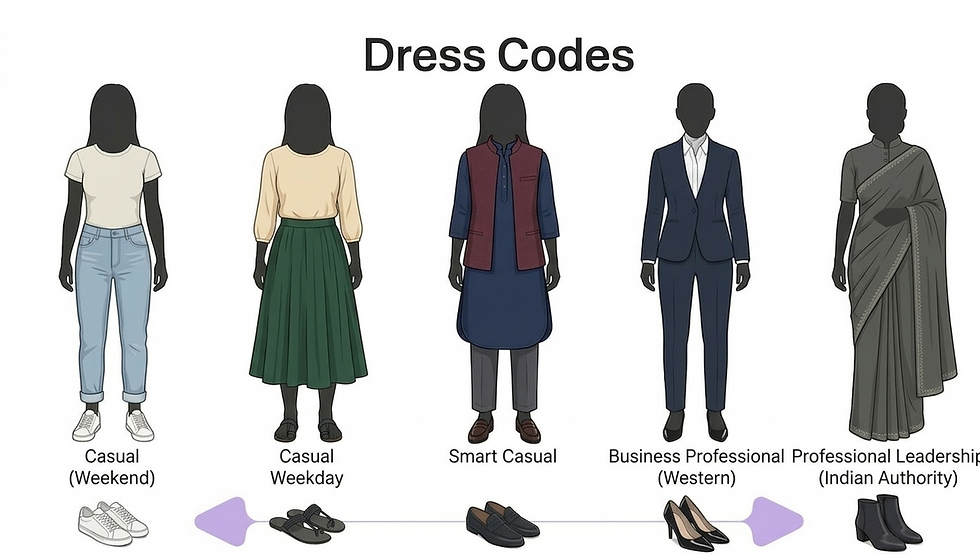
In traditional Western corporate settings, dark business suits, ties, and black lace-up shoes have long been recognised markers of formality and leadership. In India, however, the equation is more layered.
Our visual codes sit at the intersection of colonial corporate conventions and indigenous cultural cues. One only has to look at the clothing choices of Indian parliamentarians and public figures to see how authority is expressed through culturally rooted garments. Add to this the realities of tropical climate and the rapid evolution of modern startup ecosystems, and it becomes clear that understanding visual presence in the Indian context requires a different lens.
For instance, a structured cotton kurta may communicate far more credibility than a poorly constructed Western shirt. A well-cut mandarin collar can feel sharp, confident, and culturally rooted at the same time. Layering adapts to heat through garments like the Nehru or Modi jacket, which introduce structure without the thermal weight of western tailoring. Similarly, the saree, especially when paired with a well-designed and structured blouse, continues to be one of the most elegant and commanding forms of professional dress in India.

The underlying principles, however, remain the same - structure, coverage, precision, and maintenance. What changes is how those principles are expressed.
And that is where strategy comes in.
When Breaking the Rule Works
High-status individuals can violate dress codes because once authority is established, it no longer depends on reinforcement.
This is why a billionaire founder whose status is externally verified, in sneakers is still powerful.
But when credibility and capability is being negotiated,visual hierarchy matters more.
This applies especially to young professionals, early stage leaders, entrepreneurs seeking investors and woemn in male-dominated industries. Dress can serve as leverage in these moments.
The Gender Debate — Clarified
This conversation is often misunderstood as an argument about modesty or control over women’s bodies. It is neither. The same visual dynamics apply across genders. Men experience similar shifts in perception when wearing half-sleeve shirts, shorts, visible ankles, unpolished shoes, overly casual footwear, or unstructured silhouettes.
What we are really discussing is the psychology of power signaling - the subtle visual codes through which humans interpret hierarchy, credibility, and professional presence.
Everyone is free to dress as they wish. But when the goal is professional presence, it helps to understand how these signals are read.
Because the underlying principle is simple:
Authority is not fashion. It is architecture.
Professional dress functions architecturally. It contains the body, frames the silhouette, and minimizes distraction. The more structured the presentation, the easier it becomes for the observer to focus on the role rather than the individual body.
Understanding these dynamics is what separates fashion advice from visual strategy
But What About the Heat?
This is where international advice often falls short in places like India. One cannot realistically wear uncomfortably heavy wool suits in 40°C weather and expect to appear credible because physical discomfort inevitably affects posture, composure, and presence.
The real challenge therefore is not whether these signals matter, but how they can be adapted to climate.
This requires strategy rather than simple styling choices. Thinking carefully about breathable fabrics such as linen blends or tropical wool, structural tailoring that adds form without over-heating, intelligent layering that maintains hierarchy cues, and cultural calibration appropriate to the setting.
So What Is the Real Question?
The question we should be asking ourselves is not whether showing skin is right or wrong. It would be more useful to ask, "what is the objective in this room?"
If the goal is intimacy, creativity, or disruption, then relaxed visual signals may serve that purpose well. But if the goal is hierarchy, credibility, negotiation power, or leadership presence, structure tends to communicate more effectively.
Professional presence is always contextual, and understanding these signals allows us to use dress strategically rather than accidentally.
Because authority is not accidental.
It is designed.
Would you like to explore how visual authority adapts within the Indian cultural and climatic context?
If you want a deeper breakdown tailored to Indian professionals, boards, entrepreneurs, and leaders —ask me.


Comments